Inquiry-based learning within a Technology-Mediated Environment
Inquiry-based learning is a process in which learners acquire knowledge by asking questions, investigating problems, and reflecting on their understanding. Rather than passively receiving information from the teacher/instructor, students are encouraged to discover and investigate.
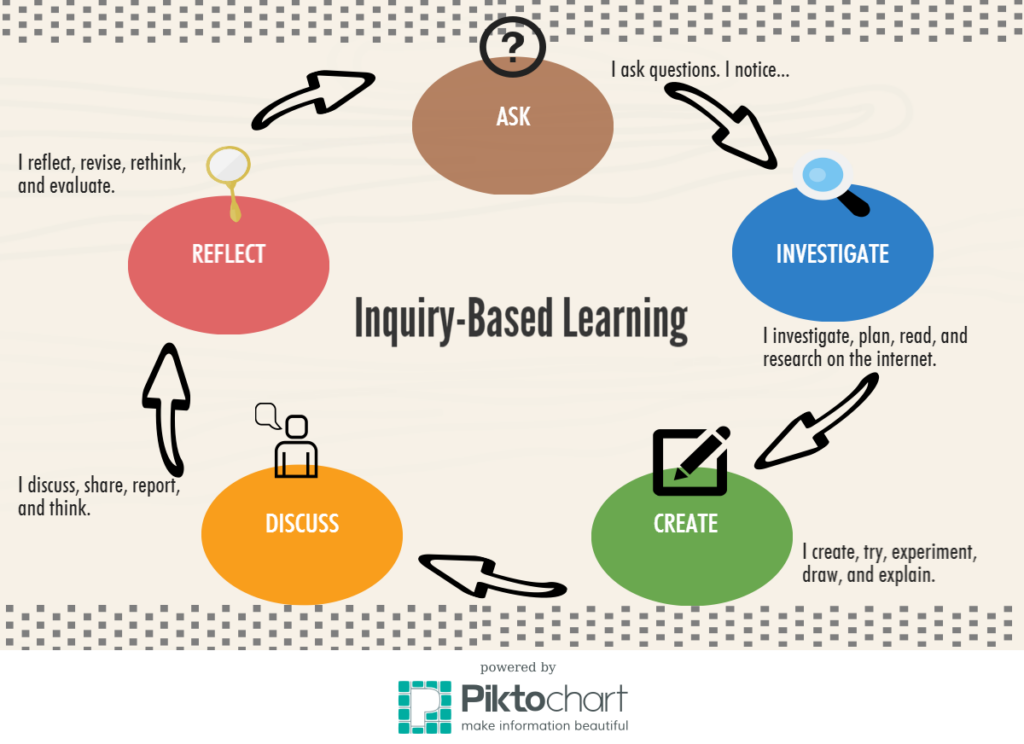
Since Bruner (2006) said that “the most uniquely personal of all that he knows is that which he has discovered for himself.” This implies that self-discovery is the primary means of meaningful learning and understanding. This aligns with constructivism, in which learning is constructed through experience and interaction with the environment.
Technology plays a huge role in supporting inquiry-based learning, which can be achieved through discussion forums or collaborative platforms, such as the Learning Pod C or the general channel in Teams. However, too much structure can reduce inquiry-based learning into a checklist, while too little guidance can lose learners’ understanding. Bruner (1961) also distinguishes between teaching in expository mode and in hypothetical mode. I’ll personally go for the hypothetical one in my design since it promotes learners to be active and participate in evaluating their thoughts, questioning ideas, and reflecting on their understanding.
Thus, scaffolding strategies come in handy when dealing with inquiry-based learning tasks because they can reduce cognitive load, provide guidance, and assist students in their ways of thinking and acting (Hmelo-Silver et al., 2007). The way my design works is I would conduct it is to include checkpoints and feedback for learners to feel as if they are supported without removing the element of discovery.
This approach will definitely have its place in my final interactive design because it promotes a deeper understanding and longer retention in learners’ memories. Upon discussion and comparison within the learning pod, we decided it’d be best to use Zoe’s experiential learning as it aligns well with our topic due to its relatability with learners’ daily experiences. Even though experiential and inquiry-based learning can sometimes overlap due to their similarities.
References
Bruner, J. S. (2006). THE ACT OF DISCOVERY. In Search of Pedagogy Volume I (pp. 67–76). Routledge. https://doi.org/10.4324/9780203088609-13
Dsouza, John. (2016, April 7). Based Learning 9: IBL — Inquiry-Based Learning. Medium. https://medium.com/innovative-learning/based-learning-9-ibl-inquiry-based-learning-89770af4babc
HMELO-SILVER, C. E., DUNCAN, R. G., & CHINN, C. A. (2007). Scaffolding and Achievement in Problem-Based and Inquiry Learning: A Response to Kirschner, Sweller, and Clark (2006). Educational Psychologist, 42(2), 99–107. https://doi.org/10.1080/00461520701263368
Kinvig, Z. (2026, June 1). Experiential Learning in the Psychology of Social Media. Zoe KinVig. https://zoekinvig.opened.ca/post-2/


Hey Bryan, really liked how you brought up the balance between too much structure and too little guidance, that’s something I’ve been thinking about with our own design too. The checkpoint idea is a smart way to keep the discovery element alive without leaving learners completely on their own. Also interesting that your pod landed on experiential learning in the end, I can see why it fits better for your topic. Good post!