I'm trying my best. :(

Tag: 5%

Post 4

460 words
2–3 minutes

In our interactive learning resource, we focused on the psychology of social media and developing healthier digital habits. Hence, one of the relevant choices would be the TED talk by Tristan Harris titled “How a handful of tech companies control billions of minds every day.” This video links perfectly with the first subtopic on how technology can be persuasive.

What kind of interaction would the video require from your students? Does it force them to respond in some way (inherent)?

This YouTube video doesn’t require any viewer interaction and is mostly a passive experience. It doesn’t prompt students to respond, but according to Chapter 10.6 Interaction: Teaching in a Digital Age, it’s still considered learner (user)-generated interactivity because it encourages reflection or analysis, applying the constructivist approach to learning. It’s also an example of learner interaction with learning materials.

In what way are they likely to respond to the video/H5P on their own, e.g., make notes, do an activity, or think about the topic (learner-generated)?

Students are likely to take notes from the video because watching the YouTube video prompts a reflection or analysis. They might reflect on their social media habits and identify the subtle details of persuasive design features embedded in their social media apps. This is a clear example of learner-generated interaction and aligns with the constructivist approach.

How could the video have been designed to generate more or better activity from viewers or students?

The video could be redesigned by integrating elements of inherent interactivity. For instance, Tristan Harris, the spokesperson, could add thought-provoking questions between each specific section for the audience to ponder. This would help transform passive activity into an interactive one, increasing retention for learners who dislike watching long or mundane videos.


How will you address any potential barriers for your learners in the use of this video to ensure an inclusive design?

To address any potential hindrances for learners, I would include accurate captions/subtitles along with a transcript of the video, which the YouTube video already provides. This would eliminate problems for people who have hearing difficulty or those who prefer reading. One thing the video lacks is the breaking into video chapters, as shown in Figure 1.
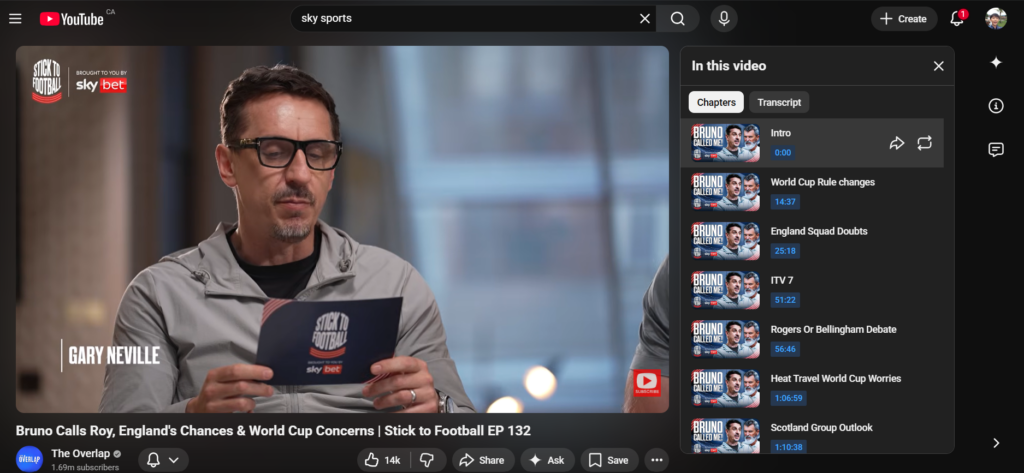
Figure 1. An example of a YouTube video with chapters displayed along with its timeframe.

Adding this feature would make the video more inclusive, and to be fair, since it was only introduced around 2020, it’s understandable why it’s missing from the TED video.

References

TED. (2017, July 28). How a handful of tech companies control billions of minds every day | Tristan Harris [Video]. YouTube. https://youtu.be/C74amJRp730?si=EBHsQwQHiol_2vxM

Bates, A. W. (2022). Chapter 10.6: Interaction. In Teaching in a Digital Age (3rd ed.). BCcampus. https://pressbooks.bccampus.ca/teachinginadigitalagev3/chapter/pedagogical-roles-for-text-audio-and-video/

The Overlap. (2026, June 9). Bruno Calls Roy, England’s Chances & World Cup Concerns | Stick to Football EP 132 [Video]. YouTube. https://youtu.be/xd50OcCjDY0?si=MMwywEs6hssMPi-D

Post 3

371 words
2–3 minutes

Where do you see the idea of the “average learner” shaping educational design?

The idea of the “average learner” shaping educational design is evident in how learning activities are often standardised into a single format and a single “expected” or “correct” way to show understanding. A great example is when I enrolled in the CIVE 299 (Geomatics Engineering) class during the Fall 2025 term (Sep 2025 – Dec 2025), where students must watch 47 lecture videos in total on Module 1, which consists of 12 lectures. This course assumes all students are best when processing information through visual and auditory approaches, which, in fact, I am not. This assumption unintentionally excludes learners who benefit from short- to long-form written or textual reading. Another instance is the “selective attention test”, which can be seen from this short video embedded below.

Believe it or not. Some viewers miss the gorilla the first time they watch, while others catch it right away. This clearly shows that learners don’t all focus on the same things at the same time, and there’s always some variability, even in a simple task.

What would change if we assumed variability was the norm?

If we assume that variability was the norm, then the whole structure of learning will change significantly in attention and engagement. One approach I would conduct is dividing learning activities into smaller, less overwhelming sections, rather than expecting students to stay focused or engaged on one task for long stretches of time. Moreover, I would emphasise more on students engaging with the content, like having students create a short video related to the material or take quick quizzes to help them stay on track with the pace of the course. This might help students to refresh their minds and feel less overwhelmed.

Overall, moving away from the idea of an “average learner” will encourage a more inclusive learning design and accommodate or facilitate all students. That’s why the “Universal Design for Learning” approach is so important—it benefits all learners by encouraging designers to shift their focus from blaming students’ limitations to improving their own designs.

References

Simons, Daniel. (2010, March 10). selective attention test [Video]. YouTube. https://youtu.be/vJG698U2Mvo?si=EwXiqQG8Z47r8A6w

University of Victoria, EDCI 335. (2023, May 1). Inclusive Learning Design. https://edtechuvic.ca/edci335/inclusive-learning-design/

University of Victoria, EDCI 335. (2023, May 1). Universal Design. https://edtechuvic.ca/edci335/universal-design/

Post 2

Inquiry-based learning within a Technology-Mediated Environment

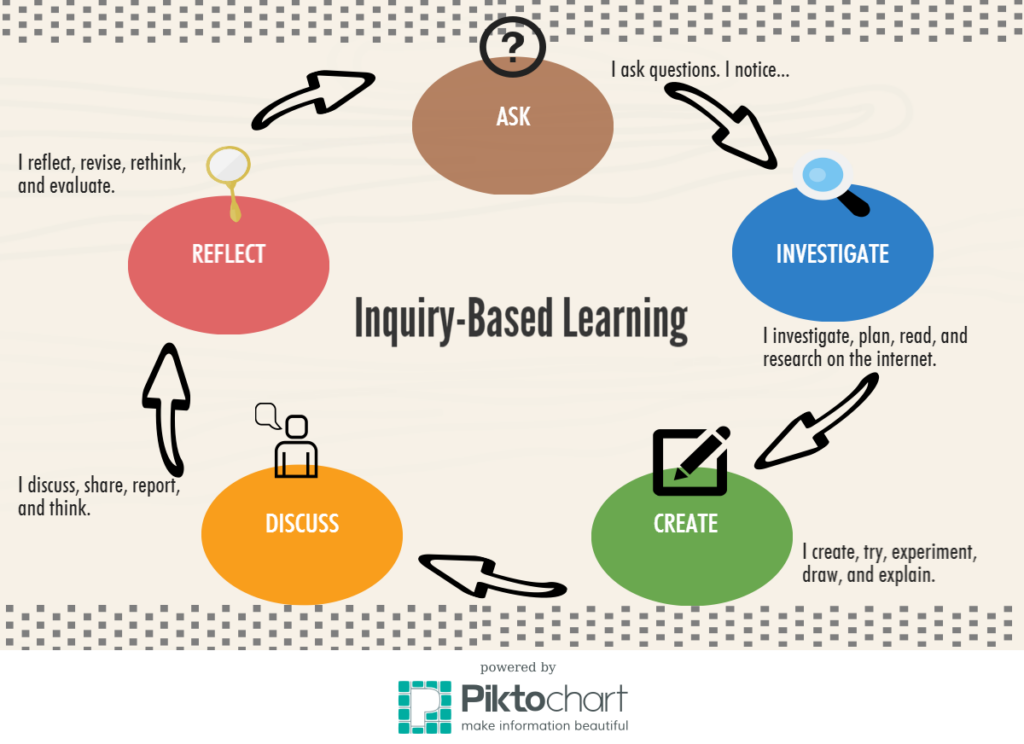
Inquiry-based learning is a process in which learners acquire knowledge by asking questions, investigating problems, and reflecting on their understanding. Rather than passively receiving information from the teacher/instructor, students are encouraged to discover and investigate.

Figure 1. Overview Process on Inquiry-based learning (John Dsouza, 2016)

Since Bruner (2006) said that “the most uniquely personal of all that he knows is that which he has discovered for himself.” This implies that self-discovery is the primary means of meaningful learning and understanding. This aligns with constructivism, in which learning is constructed through experience and interaction with the environment.

Technology plays a huge role in supporting inquiry-based learning, which can be achieved through discussion forums or collaborative platforms, such as the Learning Pod C or the general channel in Teams. However, too much structure can reduce inquiry-based learning into a checklist, while too little guidance can lose learners’ understanding. Bruner (1961) also distinguishes between teaching in expository mode and in hypothetical mode. I’ll personally go for the hypothetical one in my design since it promotes learners to be active and participate in evaluating their thoughts, questioning ideas, and reflecting on their understanding.

Thus, scaffolding strategies come in handy when dealing with inquiry-based learning tasks because they can reduce cognitive load, provide guidance, and assist students in their ways of thinking and acting (Hmelo-Silver et al., 2007). The way my design works is I would conduct it is to include checkpoints and feedback for learners to feel as if they are supported without removing the element of discovery.

This approach will definitely have its place in my final interactive design because it promotes a deeper understanding and longer retention in learners’ memories. Upon discussion and comparison within the learning pod, we decided it’d be best to use Zoe’s experiential learning as it aligns well with our topic due to its relatability with learners’ daily experiences. Even though experiential and inquiry-based learning can sometimes overlap due to their similarities.

References

Bruner, J. S. (2006). THE ACT OF DISCOVERY. In Search of Pedagogy Volume I (pp. 67–76). Routledge. https://doi.org/10.4324/9780203088609-13

Dsouza, John. (2016, April 7). Based Learning 9: IBL — Inquiry-Based Learning. Medium. https://medium.com/innovative-learning/based-learning-9-ibl-inquiry-based-learning-89770af4babc

HMELO-SILVER, C. E., DUNCAN, R. G., & CHINN, C. A. (2007). Scaffolding and Achievement in Problem-Based and Inquiry Learning: A Response to Kirschner, Sweller, and Clark (2006). Educational Psychologist, 42(2), 99–107. https://doi.org/10.1080/00461520701263368

Kinvig, Z. (2026, June 1). Experiential Learning in the Psychology of Social Media. Zoe KinVig. https://zoekinvig.opened.ca/post-2/

Post 1

A story about my best learning experience in AHVS 295B

Enrolling in AHVS 295B: Introduction to Film Studies has to be one of the best decisions that I’ve ever made. What made the course so memorable is how different it is from the required engineering courses I must enrol in. From the beginning, this course used a cognitivist approach, gradually introducing topics such as Films as Language and Genre Films, with clear links that connected new concepts to existing knowledge. This was accomplished through tutorials and lectures. However, the course also used a constructivist approach by encouraging students to share their interpretations, ideas, and debates about films such as The Player, Gentlemen Prefer Blondes, and others.

Figure 1. Still from Gentlemen Prefer Blondes (Howard Hawks, 1953)

Through these interactions, students enriched and expanded their learning experience by listening to different perspectives and opinions from their peers. Last but not least, the course embraced connectivist concepts that define learning extended beyond the classroom, such as the use of Brightspace and informal discussions in office hours or with peers, normally after class lectures. Students were not isolated in the instructor’s lecture slides or textbook, but it comes from the connections/interactions between peers, media, and digital resources. According to connectivism, knowledge is transferred across a network and not confined to individuals alone. Furthermore, the course is integrated with behaviourism, which was evident in how tutorial participation is reinforced by including it in the grade total contribution of 10%, creating a consequence of grade impact. Not to mention, the course repeatedly instructed students to include screening notes, construct a point-form outline, and an introduction. This encourages students to develop a routine when dealing with the assignments.

Why did I enjoy it?

I thoroughly enjoyed this learning in this course because it let me choose which films I wish to write about between a certain time, such as from January 6 and January 27, for an assignment. Moreover, before enrolling in this course, my interest in film has always been there since I was a child. This occurs because of my parents’ love for movies, so it naturally rubbed off on me.

References

Ertmer, P. A. & Newby, T. (2018). Behaviorism, Cognitivism, Constructivism: Comparing Critical Features From an Instructional Design Perspective. In West, R. E. (Ed.), Foundations of Learning and Instructional Design Technology (1st Edition): Historical Roots and Current Trends (pp. 133-151). EdTech Books. https://edtechbooks.org/lidtfoundations/behaviorism_cognitivism_constructivism

Hawks, Howard. (Director). (1953). Gentlemen Prefer Blondes [Film]. Twentieth Century Fox.

Weller, M. (2020). Connectivism. 25 years of EdTech. Athabasca University Press. https://read.aupress.ca/read/25-years-of-ed-tech/section/198057f5-1a3e-4436-a4b8-c6e1a3e0bd69

© 2026 Bryan Soetjipto

Theme by Anders NorenUp ↑