
In our interactive learning resource, we focused on the psychology of social media and developing healthier digital habits. Hence, one of the relevant choices would be the TED talk by Tristan Harris titled “How a handful of tech companies control billions of minds every day.” This video links perfectly with the first subtopic on how technology can be persuasive.
What kind of interaction would the video require from your students? Does it force them to respond in some way (inherent)?
This YouTube video doesn’t require any viewer interaction and is mostly a passive experience. It doesn’t prompt students to respond, but according to Chapter 10.6 Interaction: Teaching in a Digital Age, it’s still considered learner (user)-generated interactivity because it encourages reflection or analysis, applying the constructivist approach to learning. It’s also an example of learner interaction with learning materials.
In what way are they likely to respond to the video/H5P on their own, e.g., make notes, do an activity, or think about the topic (learner-generated)?
Students are likely to take notes from the video because watching the YouTube video prompts a reflection or analysis. They might reflect on their social media habits and identify the subtle details of persuasive design features embedded in their social media apps. This is a clear example of learner-generated interaction and aligns with the constructivist approach.
How could the video have been designed to generate more or better activity from viewers or students?
The video could be redesigned by integrating elements of inherent interactivity. For instance, Tristan Harris, the spokesperson, could add thought-provoking questions between each specific section for the audience to ponder. This would help transform passive activity into an interactive one, increasing retention for learners who dislike watching long or mundane videos.
How will you address any potential barriers for your learners in the use of this video to ensure an inclusive design?
To address any potential hindrances for learners, I would include accurate captions/subtitles along with a transcript of the video, which the YouTube video already provides. This would eliminate problems for people who have hearing difficulty or those who prefer reading. One thing the video lacks is the breaking into video chapters, as shown in Figure 1.
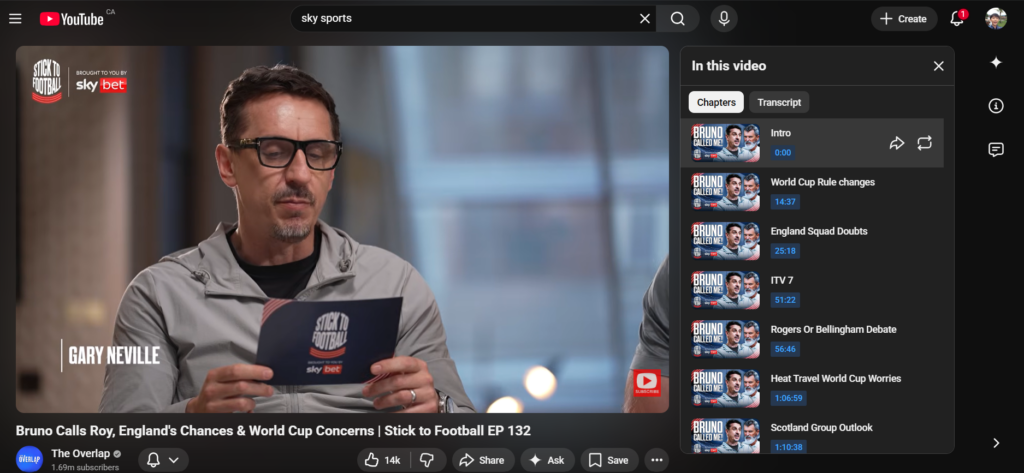
Adding this feature would make the video more inclusive, and to be fair, since it was only introduced around 2020, it’s understandable why it’s missing from the TED video.
References
TED. (2017, July 28). How a handful of tech companies control billions of minds every day | Tristan Harris [Video]. YouTube. https://youtu.be/C74amJRp730?si=EBHsQwQHiol_2vxM
Bates, A. W. (2022). Chapter 10.6: Interaction. In Teaching in a Digital Age (3rd ed.). BCcampus. https://pressbooks.bccampus.ca/teachinginadigitalagev3/chapter/pedagogical-roles-for-text-audio-and-video/
The Overlap. (2026, June 9). Bruno Calls Roy, England’s Chances & World Cup Concerns | Stick to Football EP 132 [Video]. YouTube. https://youtu.be/xd50OcCjDY0?si=MMwywEs6hssMPi-D


Hi Bryan,
I really enjoyed reading your post! I like how you connected the learning activity to real-world situations and encouraged students to think critically rather than just memorize information. Your ideas were clear, practical, and easy to follow. I also appreciate the way you made the activity engaging and meaningful for learners.
Great job!